Choosing the right liquid filler can save time, reduce waste, and improve consistency across every bottle or batch.
This roundup of precision liquid filling machines focuses on practical accuracy, speed, and ease of use for different product types and production sizes.
Best 10 Precision Liquid Filling Machines Picks for 2026
Precision Micro-Batch Filler
2025 New Version 2-300g Peristaltic Bottle Filler

- Automatic weight-based filling with slow-down near target
- Peristaltic pump limits liquid contact to silicone tubing
- 3 fill modes plus stepless speed control
Best For: Small-batch filling of thin liquids with clean, accurate dispensing
High-Flow Precision Filler
VEVOR 30-15000g Automatic Paste Liquid Machine

- Digital weighing system with automatic tare and stop
- High flow rate up to 17L/min for low-viscosity liquids
- 6 nozzle sizes and adjustable lifting rod for container fit
Best For: Small-batch production that needs fast, weight-based filling
Mini Accuracy Filler
Hanchen 1-50ml Peristaltic Weighing Machine
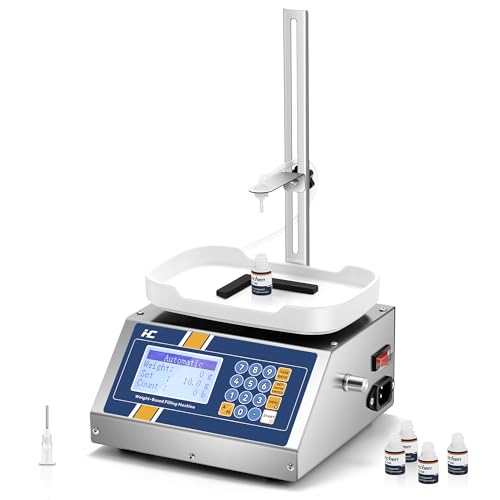
- Up to 0.1ml/0.1g accuracy for very small fills
- Automatic tare, slow-down, stop, and reset functions
- Simple two-step operation for upright bottles
Best For: Small-volume filling of water-like liquids with repeatable accuracy
Compact Filling Line
4-Nozzle Desktop Bottle Filler with Conveyor

- Integrated conveyor, sensor, and filling system
- 1-4 nozzle setup for adjustable packaging speed
- Independent speed control for each pump
Best For: Small enterprises needing a compact line for thin liquids
Weight-Based Precision
CSY-3200 Weighing Diaphragm Pump Filler
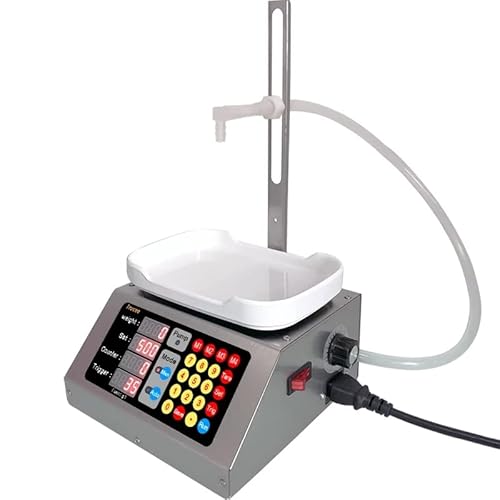
- 10g to 3000g filling range
- 1g division value for precise weight control
- Diaphragm pump keeps liquid out of the pump
Best For: Medium or low-viscosity liquids filled by weight
Small-Bottle Accuracy
HD1360 Precision Needle Bottle Filler

- 1mm needle nozzle for narrow-neck bottles
- LCD control with auto-stop dispensing
- Manual, auto interval, and jog modes
Best For: Tiny, repeatable fills for narrow-neck bottles
Multi-Channel Speed
4 Head Thin Liquid Filling Machine

- Four independent filling channels
- 100 fl oz/min pump on each channel
- Quick-connect tubing for easier cleaning
Best For: Fast filling of thin, non-corrosive liquids
Digital Precision Filler
1-105Oz Peristaltic Bottle Filler

- Weighing or timing fill modes
- ≤1g filling error claim
- 6 saved data presets
Best For: Small-to-medium bottling of compatible liquids with tight fill control
GFK280 Bulk Filler
5-3500ml Automatic Liquid Pump

- 5-3500ml filling range
- Repeat error less than ±1%
- Manual or automatic operation
Best For: Low-viscosity, noncorrosive liquids in varied bottle sizes
Dual-Head Mini Filler
5 Oz Peristaltic Bottle Machine

- Accuracy up to ±1%
- Two independent filling channels
- SUS304 nozzles included
Best For: Small-bottle jobs under 5 oz with separate dual-channel control
Precision Micro-Batch Filler – 2025 New Version 2-300g Peristaltic Bottle Filler
If you need precision liquid filling machines for small bottles and low-viscosity products, this 2025 version is built around accuracy and simplicity. It uses weight-based control with automatic taring, slowing down near the target so you can fill perfume, essential oil, MCT oil, nail polish, and similar liquids with less overflow and less guesswork.
Best For: Small-batch filling of thin liquids where clean, accurate dispensing matters more than raw speed.
Pros:
- Automatic tare, start, slow-down, and stop functions reduce manual steps.
- Peristaltic pump keeps liquid in the silicone tube, helping prevent contamination.
- 3 modes: weight-based, time-based, and price-based for flexible setup.
- Stepless speed adjustment helps match different bottle and liquid types.
Cons:
- Best suited to thin or low-viscosity liquids, not thicker formulas.
- Capacity is limited to 2-300g, so it is not for large containers.
- Designed for bottle filling, not broader production-line use.
Overall, this is a practical pick if you want a compact precision filler that prioritizes clean operation and easy control over complex programming. The included 4mm and 6mm nozzles add some flexibility for different bottle openings.
High-Flow Precision Filler – VEVOR 30-15000g Automatic Paste Liquid Machine
Among precision liquid filling machines, this VEVOR model stands out when you need a wider fill range and much higher throughput. Its digital weighing system handles automatic tare and stop functions, while the diaphragm pump is aimed at low- to medium-viscosity liquids like oil, shampoo, detergent, yogurt, and drink products.
Best For: Small-batch production that needs faster filling across a broad weight range.
Pros:
- Large 30-15000g range supports everything from small containers to bigger fills.
- High flow rate up to 17L/min for low-viscosity liquids.
- Adjustable lifting rod and 6 nozzle sizes improve container fit.
- Food-grade materials and removable hose make cleaning easier.
Cons:
- Thicker liquids may flow more slowly than low-viscosity products.
- Designed for medium-low viscosity, so it is not ideal for paste-heavy applications.
- At 17.2 pounds, it is less portable than smaller tabletop fillers.
This is a strong choice if your priority is speed without giving up weighing-based control. It is better suited to workshop or small production use than ultra-fine micro-filling.
Mini Accuracy Filler – Hanchen 1-50ml Peristaltic Weighing Machine
If you are comparing precision liquid filling machines for very small volumes, this Hanchen unit is focused on bottle-to-bottle consistency. It uses a high-precision peristaltic pump with weight-based control, automatic slowing near the end of each fill, and simple two-step operation for low-viscosity liquids.
Best For: Small-volume filling of water-like liquids where repeatable accuracy is the main goal.
Pros:
- Accuracy is listed at up to 0.1ml/0.1g for small fills.
- Automatic tare, start, slow-down, stop, and reset reduce operator effort.
- Peristaltic pump is suitable for essential oil, perfume, oral liquid, and similar products.
- Simple operation: put on the bottle, then take it off when done.
Cons:
- Only suitable for low-viscous, non-corrosive liquids without solid particles.
- Not intended for paste, honey, or fuel-like liquids.
- Requires upright bottles and is not meant for bags.
For micro-batch filling, this model is appealing because it emphasizes accuracy and simplicity over versatility. It is a good fit when your products are thin and your containers are small.
Compact Filling Line – 4-Nozzle Desktop Bottle Filler with Conveyor
For buyers comparing precision liquid filling machines in a small production setting, this 4-nozzle desktop line is built to automate filling and bottle movement together. It combines a filling unit, belt conveyor, and infrared sensor, making it a better fit for repeatable throughput than a single-bottle tabletop filler.
Best For: Small enterprises that want a compact filling line for thin liquids.
Pros:
- Integrated conveyor, sensor, and filling system support automated workflow.
- 1-4 nozzle configuration can be set for different packaging speeds.
- Independent pump speed control helps match different bottle sizes.
- Adjustable 35-inch conveyor adds flexibility for desktop production.
Cons:
- Not suitable for viscous liquids like oil or gel.
- Not recommended for fluids with seeds, pulps, or chemical solutions like acetone.
- Bottle size and shape must fit the stated diameter and height limits.
This model makes sense if you want a more automated setup without moving to a full industrial line. It is strongest where the liquid is thin and the bottles are consistent.
Weight-Based Precision – CSY-3200 Weighing Diaphragm Pump Filler
If you want precision liquid filling machines that dose by weight instead of volume, the CSY-3200 is built for controlled small-to-medium batches. It uses an electronic scale and a high-precision diaphragm pump, so the liquid does not pass through the pump, which is a useful fit for food and other compatible liquids that need cleaner handling.
Best For: Users filling medium or low-viscosity liquids like edible oil, drinks, disinfectant, and cosmetics by target weight.
Pros:
- Fills from 10g to 3000g with 1g division value for weight-based accuracy.
- Diaphragm pump design keeps liquid from passing through the pump.
- Adjustable working speed and flow up to 3.5L/min.
- Suitable for a range of non-strong-acid, non-strong-alkali liquids without solid particles.
Cons:
- Not intended for strong corrosion or liquids with solid particles.
- Best performance is limited to bottles up to 32cm tall.
- Less focused on very high-speed multi-nozzle production.
Overall, this is a practical pick when weight-based consistency matters more than raw throughput. It offers a straightforward setup for controlled filling jobs where liquid compatibility and repeatability are the main priorities.
Small-Bottle Accuracy – HD1360 Precision Needle Bottle Filler
For precision liquid filling machines aimed at narrow-neck containers, this compact bottle filler is designed around small-volume accuracy and easy control. The HD1360 model uses a handheld needle nozzle and stepper motor-based quantitative filling, making it a strong match for tiny, repeatable fills in labs, studios, and small-batch production.
Best For: Small bottles and narrow-neck containers filled with essential oils, perfume samples, oral liquids, eye drops, and herbal extracts.
Pros:
- 1mm needle filling support for narrow-neck bottles with inner diameter 2mm or larger.
- Digital LCD control with auto-stop for stable, accurate dispensing.
- Manual, auto interval, and jog modes add flexibility for different workflows.
- Compact and portable design suits small workshops and labs.
Cons:
- HD1360 is limited to 1-30ml and is meant for small-volume liquids.
- Designed for low-viscosity, non-particulate liquids only.
- Not intended for heavier industrial batch filling.
This machine makes sense if your priority is controlled dispensing into difficult small openings rather than large-volume speed. The narrow-nozzle setup and simple control panel are the standout features for precision work.
Multi-Channel Speed – 4 Head Thin Liquid Filling Machine
If you need precision liquid filling machines that also speed up throughput, this 4-head model is built for fast handling of thin liquids. Each channel is independent, so you can fill different liquids or different volumes at the same time, which is useful when you want simple, parallel production for water-like products.
Best For: Filling thin, non-corrosive liquids like wine, juice, and glass detergent in small production runs.
Pros:
- Four independent filling channels let you run multiple fills at once.
- Each channel uses a 100 fl oz/min pump for fast filling.
- Simple panel with clear display and per-pump speed adjustment.
- Quick-connect tubing makes cleaning and setup easier.
Cons:
- Only suitable for water-like, particle-free, non-corrosive liquids.
- Not suitable for lotion, gel, or hot sauce.
- Requires tubing setup for inlet and outlet connections.
This is the strongest option here when speed and multiple filling points matter more than handling thicker products. Its four-channel layout and independent controls make it a practical choice for thin-liquid bottling tasks.
Digital Precision Filler – 1-105Oz Peristaltic Bottle Filler
If you need precision liquid filling machines for small-to-medium production runs, this digital peristaltic filler is built for accurate, repeatable bottle filling without exposing the liquid to the machine internals. It supports both weighing and timing modes, and the digital screen shows measurements to two decimal places for tighter control.
Best For: Users filling wine, juice, oil, perfume, or other compatible liquids who want flexible, high-accuracy bottling from 1 to 105 oz.
Pros:
- Peristaltic pump keeps liquid confined to food-grade silicone tubing for easier cleaning and changeovers
- Selectable weighing or timing fill modes with digital display and 6 saved data presets
- Claims filling error of ≤1g, with automatic frequency conversion near target weight for better accuracy
- Adjustable speed up to 112 oz/min and automatic bottle-detect start/stop functions
Cons:
- 110V unit, so power compatibility matters
- Best suited to compatible liquids rather than thick or highly challenging materials
- Single filling head may be slower than multi-nozzle setups for larger batches
This model is a strong fit if your priority is clean handling and accurate small-batch filling with minimal manual adjustment. The combination of saved presets, auto behavior, and peristaltic design makes it practical for routine bottling work.
GFK280 Bulk Filler – 5-3500ml Automatic Liquid Pump
For buyers comparing precision liquid filling machines that can handle a wider fill range, this automatic digital pump filler covers 5 to 3500 ml with either manual control or automatic operation. It uses microcomputer control and an LCD display to help keep filling volume consistent, while the stainless steel build is positioned for longer-term use.
Best For: Filling low-viscosity, noncorrosive liquids like water, ink, juice, perfume, or olive oil in larger volume ranges.
Pros:
- Wide filling range from 5-3500 ml for flexible bottle and container sizes
- Automatic counting function and LCD display for better volume control
- Repeat error listed at less than ±1% for more uniform filling
- Stainless steel construction and pump design suited to long-term use
Cons:
- Not suitable for thick pastes
- Not suitable for carbonated drinks
- Lower max flow rate than some higher-output bottlers at 3.2 L/min
This is a practical choice when you want broad volume coverage without stepping up to a more complex industrial line. Its strength is controlled, repeatable filling for compatible liquids rather than high-speed heavy-duty production.
Dual-Head Mini Filler – 5 Oz Peristaltic Bottle Machine
If your precision liquid filling machines shortlist is focused on small bottles, this 2-head peristaltic filler is designed for accuracy up to ±1% with independent filling channels. The peristaltic design keeps liquid limited to the tubing, which makes cleanup easier and helps with switching between compatible liquids.
Best For: Small-bottle filling under 5 oz for perfume, water, juice, and other non-viscous liquids that benefit from two independent fill channels.
Pros:
- Accuracy up to ±1% for precise small-bottle filling
- Two independent filling channels for separate control of each nozzle
- Only the tubing contacts the liquid, supporting easier cleanup and tubing swaps
- Includes 4mm and 6mm SUS304 nozzles for small bottle openings
Cons:
- Viscous liquids are not suitable
- Working capacity is aimed at bottles smaller than 5 oz
- Requires tubing compatibility with the liquid being filled
This model makes the most sense for compact packaging workflows where accuracy and cleanliness matter more than maximum fill volume. The dual-channel layout is especially useful if you want separate control over two fills at once.
How We Picked These Precision Liquid Filling Machines
We prioritized filling range, dosing accuracy, liquid compatibility, nozzle configuration, control simplicity, and whether a machine fits home, lab, small business, or light production use. We also looked for models that can handle common products such as water, wine, juice, oil, perfume, shampoo, and other low- to medium-viscosity liquids.
Quick Comparison
If you need small-volume precision, peristaltic and weighing-based units are usually the best fit. For higher throughput, multi-nozzle and conveyor-style systems are better suited to repetitive bottling. Diaphragm and pump-based designs can offer more flexibility when dealing with thicker or more variable liquids.
Key Buying Factors for Precision Liquid Filling Machines
Fill Range and Accuracy
Check the minimum and maximum fill range first. A machine that is accurate at 10 ml may not be the best choice for 1,000 ml fills. Match the fill window to your real product sizes, and prefer models with clear digital control if repeatability matters.
Liquid Type and Viscosity
Not every filler handles every liquid well. Thin liquids like water, alcohol, and perfume generally work well with peristaltic systems, while thicker products such as oil, detergent, or shampoo may benefit from pump or diaphragm designs. Confirm whether the machine is intended for low-, medium-, or thicker-viscosity liquids before buying.
Nozzles, Speed, and Workflow
Single-nozzle machines are usually simpler and better for small runs. Multi-nozzle systems improve output, but they also require more setup, more consistent bottle placement, and more space. Conveyor-based models are best when you need a more streamlined production line.
Ease of Cleaning and Changeover
If you switch between products often, cleaning time becomes a major factor. Look for straightforward tubing access, removable parts, and designs that minimize residue buildup. This is especially important for cosmetic, food, and beverage applications.
Who Should Buy Which Precision Liquid Filling Machines?
Small sellers, labs, and startup brands often do best with compact Precision Liquid Filling Machines that offer digital control and a narrow fill range. Growing businesses that need better throughput should look at multi-head or conveyor systems. If your liquids vary widely in viscosity, choose a flexible pump-based filler rather than a highly specialized setup. For the best results, buy for your current bottle sizes and your next six to twelve months of production, not just today’s output.